

National Garden
The National Garden is a magnificent example of 19th-century landscape architecture (English style) that has managed to preserve its core characteristics intact. The feeling of a natural landscape, the presence of a complex winding network of paths, the distinct botanical sections, the strong presence of water, the small-scale flower beds or lawns, and its historical plantings dominate to this day, creating an oasis in the center of Athens—a significant attraction for young and old, Greeks and foreign visitors alike.
Its evolution and course are directly linked to the founding of the modern Greek state and the development of Athens into a modern European capital, and its significance extends beyond our country’s borders.
Its construction began in 1839 and is considered the most successful project of Queen Amalia. It is the only historical garden in the country and the first landscaped green space of Modern Greece. In its early years, it served as the Palace Garden (the current Hellenic Parliament building). In 1923 it was designated as a state garden, and in 1927 the Legal Entity “Committee of Public Gardens and Tree Lines – National Garden” was established, operating until 2004. Since then, and for a total of 95 years, the City of Athens has held the responsibility for managing the National Garden. In 2011, the Garden was officially designated as a Historical Site by a decision of the Ministry of Culture (Government Gazette AAΠ 49/23.03.2011).
Access
The National Garden is open to the public daily from sunrise to sunset, and visitors can access it through its various entrances. Access for People with Disabilities (PWD) is possible through the Garden’s entrances (excluding the Vas. Sofias and Jean Moreas entrances), while movement within the Garden is comfortable and pleasant. In extraordinary cases or for security reasons or any other cause, the operating hours are modified. In such cases, relevant announcements are posted at the entrances or on social media to inform visitors.
Contact
Telephone: 210 7215019, 210 7214897
National Garden Children’s Library: 210 3236503
Email: t.ethnikou.kipou@athens.gr
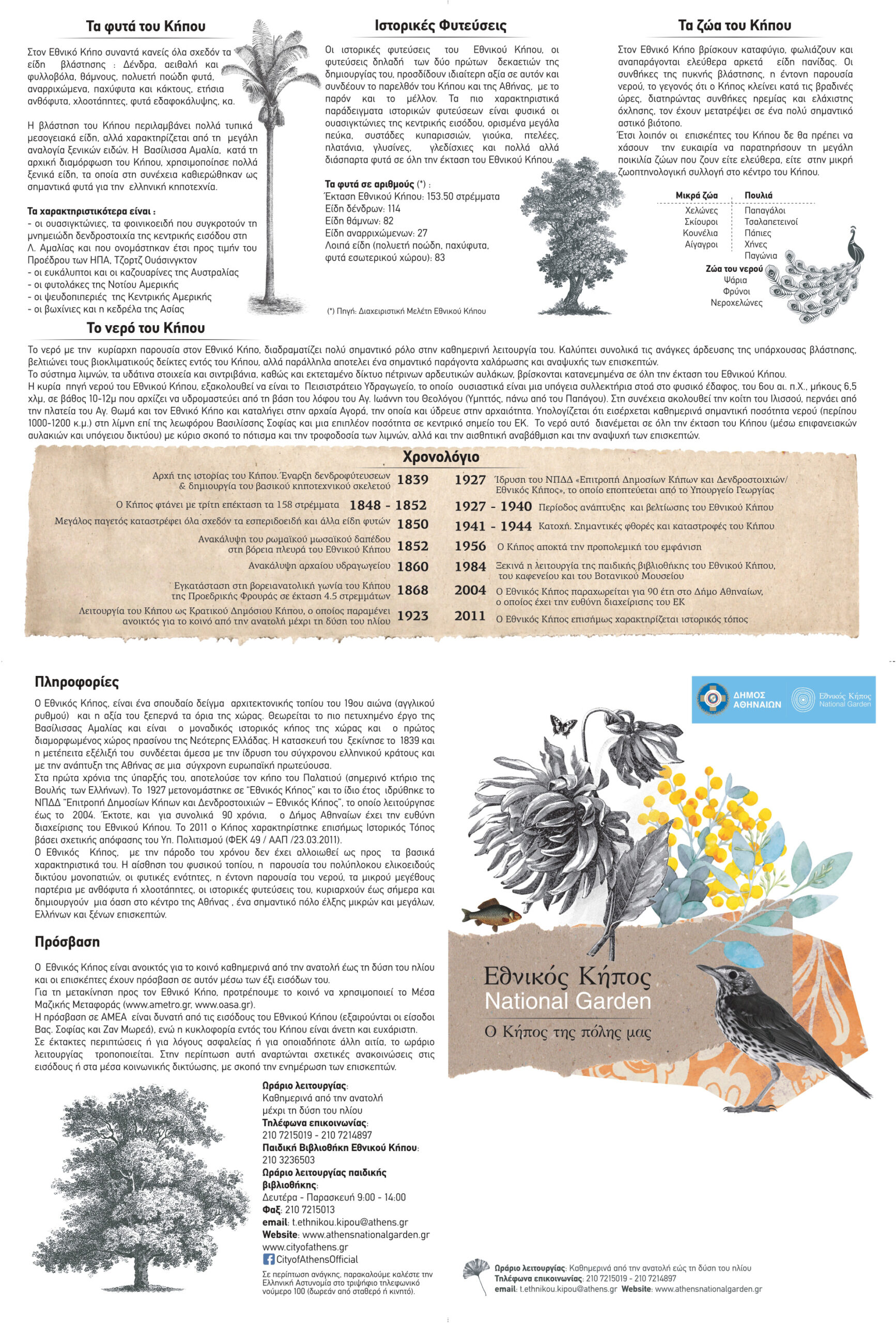

Plants of the Garden
In the National Garden, one encounters almost all types of vegetation: evergreen and deciduous trees, shrubs, perennial herbaceous plants, climbers, succulents and cacti, annual flowering plants, lawns, groundcover plants, etc. The Garden’s vegetation includes many typical Mediterranean species but is characterized by a large proportion of exotic species. Queen Amalia, during the initial landscaping of the Garden, used many exotic species which subsequently became established as important plants in Greek gardening.
The most characteristic are:
- Washingtonias: the palm trees that form the monumental tree line at the main entrance on Amalias Ave., named in honor of the US President, George Washington.
- Eucalyptus and Casuarinas from Australia,
- Phytolaccas from South America,
- False pepper trees from Central America, etc.
- Chinese Ailanthus
Historical Plantings
The historical plantings of the National Garden—those from the first two decades of its creation—add special value to it and link the Garden’s and Athens’ past with the present and future. The most characteristic examples are the Washingtonias at the main entrance, certain large pines, cypress groves, yuccas, elms, plane trees, wisterias, honey locusts, and many other plants scattered throughout the National Garden.
Animals
Several species of fauna find refuge, nest, and reproduce freely in the National Garden. The conditions of dense vegetation, the strong presence of water, and the fact that the Garden closes during the night—maintaining conditions of calm and minimal disturbance—have turned it into a very important urban habitat. Visitors should not miss the opportunity to observe the wide variety of animals living either freely or in the small zoo-botanical collection in the center of the Garden.
Birds
Parrots
Hoopoes
Ducks
Geese
Peacocks
Small Animals
Turtles
Squirrels
Rabbits
Wild goats
Aquatic Animals
Terrapins
Fish
Toads
Water
Water, with its dominant presence in the National Garden, plays a very important role in its daily operation. It fully covers the irrigation needs of the existing vegetation and improves bioclimatic indicators within the Garden, while simultaneously serving as a major factor for relaxation and recreation for visitors. The system of lakes, water elements, and fountains, as well as an extensive network of stone irrigation channels, are distributed throughout the National Garden. The main water source remains the Peisistratian Aqueduct, which is essentially an underground collecting gallery in the natural soil dating back to the 6th century BC. It is 6.5 km long, at a depth of 10-12m, and begins its water collection from the base of St. John the Theologian hill (Hymettus, above Papagou). It then follows the bed of the Ilissos river, passes through St. Thomas Square and the National Garden, and ends at the Ancient Agora, which it supplied in antiquity. It is estimated that a significant amount of water (approximately 1,000-1,200 cubic meters) enters the lake on Vasilissis Sofias Avenue daily, with an additional amount at a central point of the National Garden. This water is distributed throughout the Garden (via surface channels and an underground network) primarily for irrigation and supplying the lakes, as well as for aesthetic enhancement and visitor recreation.

Όλα τα άρθρα σχετικά με "National Garden"
Δεν βρέθηκαν άρθρα για αυτή την κατηγορία.